Most of the complaints a management committee hears come from about two hours a day. Morning departure and evening return, when the gate backs up onto the main road and somebody parks across the loading bay.
Traffic rarely appears in a guarding contract as its own line, which is why it is usually done badly. The peak-hour surge lands on whoever happens to be at the gate, the queue spills out onto the main road, and the committee hears about it at every monthly meeting.
Staffing those hours on purpose is cheap next to the goodwill it buys. One extra pair of hands at the boom gate for two hours in the morning and two in the evening changes the daily experience of every resident in the block, and that daily experience is what they judge the whole security contract on.
Parking enforcement is the other half, and it works as a record instead of an argument. A guard debating a bay with an owner in front of an audience helps nobody and usually ends up in a complaint against the guard. A photograph with a time, sent to the management office, lets your Joint Management Body enforce its own by-laws. Two other things belong here in a Malaysian development: the e-hailing pickup point, which turns into a bottleneck if it is not designated, and the fire engine accessway, which has to stay clear whether or not anyone is watching.
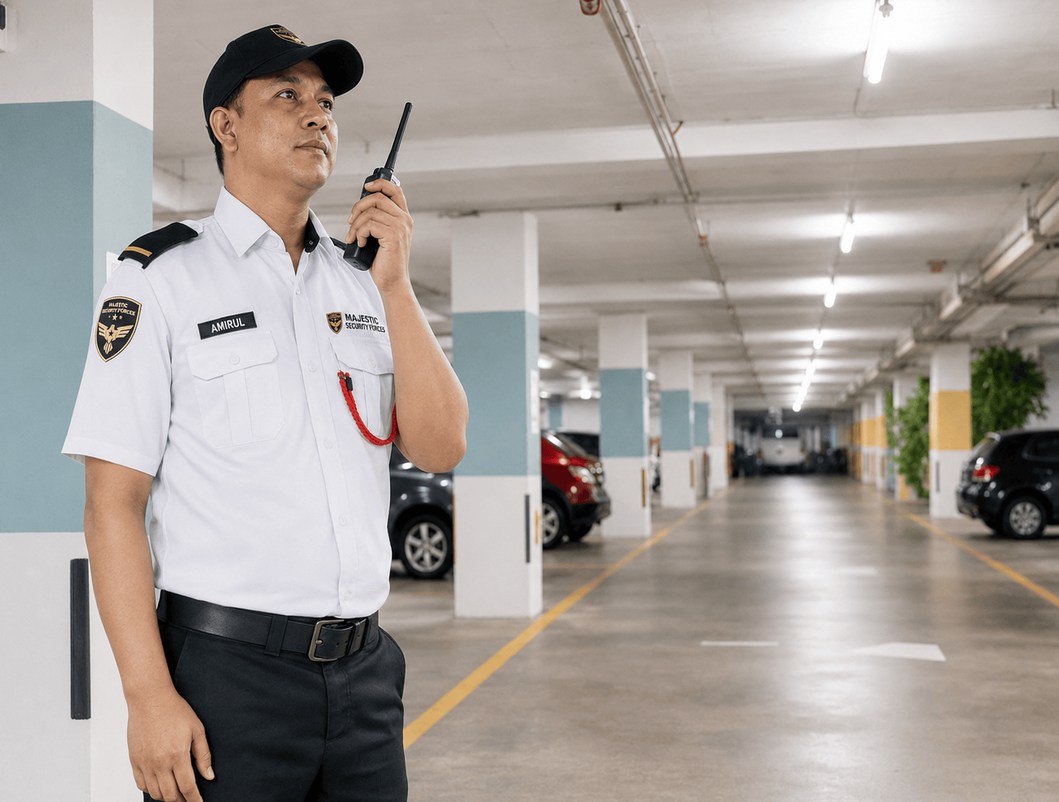
Directing flow through morning and evening peak so the queue never reaches the public road.
Allocation and turnover under your by-laws, so a bay is not occupied all week by the same vehicle.
Grab and delivery riders directed to the designated pickup point instead of stopping across the entrance ramp.
Deliveries and move-outs scheduled away from the peak, and checked against the renovation permit from the management office.
Time-stamped photo records sent to the management office, giving the committee something enforceable to act on.
Fire engine accessways and hydrant approaches checked on every round. A blocked accessway is a compliance finding, not an inconvenience. See security patrol.
Where one boom gate carries the whole development and the queue is a daily complaint.
Heavy contractor and lorry traffic on top of normal resident movement.
Tenant, visitor and delivery vehicles competing for the same ramp.
Not on their own authority, and you should be wary of an agency that says otherwise. Guards record the obstruction with a time and a photograph and send it to the management office. Whether the property clamps, fines or issues a warning is a decision for the Joint Management Body or Management Corporation under its by-laws, and under the Strata Management Act 2013 that authority sits with the committee, not with a contractor standing at the gate.
Often only for the peak window. Pulling the entry-point guard onto traffic duty leaves the gate uncontrolled, which trades one problem for a worse one, so peak cover is usually quoted as additional hours rather than as a full extra post.
Fire engine accessways are checked on the patrol round and any obstruction is escalated straight away. Treat it as a compliance matter and not a convenience one: a blocked accessway is the finding that causes a property real trouble during a Bomba inspection, and it is the one item where a guard should move a car owner along without waiting for the committee.
The gate is where residential security either works or quietly stops working.
Read more Roving CoverA patrol without fixed checkpoints and fixed timings is a guard going for a walk.
Read more Core ServiceThe service most Malaysian properties are really buying.
Read moreSend the property name, how many entry points you have and the shift pattern you run now. You get back a written proposal with the guard count, the roster and the monthly figure. If a smaller deployment does the job, we will say so in the same message.
Request a Site Assessment