Incident Response

A break-in, a fire alarm, a medical case in the lift lobby or a fight at the gate. What separates agencies is not whether the guard reacts, it is whether management hears about it within the hour and in writing.

01Escalation

You Should Hear It From Us First

The standard is plain, and most committees tell us their previous agency missed it: you learn about the incident from the security company, not from a resident posting photographs in the building WhatsApp group at midnight.

Two things make that possible. A guard who knows what to do in the first five minutes, and an escalation path that does not dead-end at a supervisor who is asleep. Both go into the post orders before deployment, and both are why we ask early on which committee member is willing to be woken at 2am.

The written report carries more weight than it sounds like it should. A Joint Management Body facing an insurance claim, a police report at the balai or an owner threatening to take it to the Commissioner of Buildings needs a document with a time, a category, an action and a follow-up. A verbal account at the next monthly meeting does very little for any of the three.
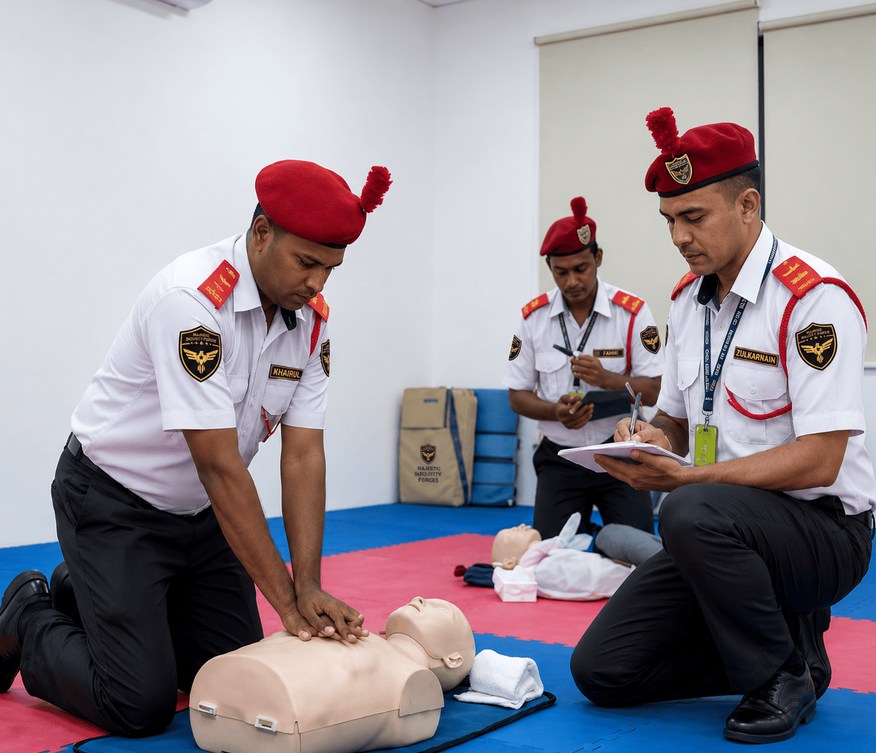
Emergency Drill Guards practising CPR on a training mannequin during an emergency response drill

At a Glance

  • Trained first reaction
  • Same-hour escalation
  • Authorities contacted
  • Lift entrapment handling
02Scope of Work

What the Response Involves

Trained first reaction

Guards covered on first-aid awareness, fire response and evacuation during induction and refresher training.

Same-hour escalation

Supervisor and operations alerted while it is still happening, and your property manager notified through the agreed channel.

Authorities contacted

PDRM at the nearest balai or Bomba dan Penyelamat called when the situation calls for it, and the report reference written down.

Lift entrapment handling

The procedure for a stuck lift agreed in advance with your lift contractor, because in a Klang Valley high-rise this is the call guards field most often.

Written incident report

Date, location, category, action taken, photo evidence and the follow-up that closed it.

Pattern tracking

Repeat incidents flagged in the monthly report, because three events in one staircase is a different problem from three unrelated ones.

03Process

The First Hour

Step 1 Guard acts Safety first, following the escalation written into the post orders for that category of incident.
Step 2 Supervisor verifies Attends the site and establishes what happened instead of relaying one guard’s version of it.
Step 3 Management informed Your property manager or committee contact is told through the agreed channel, within the hour for anything critical.
Step 4 Report filed Written up the same day with evidence attached, and the follow-up tracked until it is closed.
04Suitability

Where This Matters Most

Properties with a recent break-in

Where residents have lost confidence and the committee needs visible, documented response.

High-rise residential

Medical cases, lift entrapments and fire alarms all need a guard who knows the building and the escalation order.

Commercial sites after hours

When nobody from management is on site and the guard is the entire first response.

05Common Questions

Questions About Incident Response

Are your guards trained in first aid?

Guards receive first-aid awareness and fire response as part of induction and refresher training, which prepares them to act sensibly in the first minutes and to call the right people. They are not paramedics, and any agency claiming a guard force of medical responders is overselling. The value is a correct, fast escalation.

Will you make the police report for us?

Guards contact PDRM, secure the area and write down the reference. Whether the property itself lodges a report at the balai is your committee’s decision, and our incident report is drafted so it can be attached to one. We do not lodge reports on a property’s behalf without instruction, because the complainant needs to be the party with standing.

What counts as critical enough to call at 2am?

It is agreed with you in writing before deployment, and it varies by building. Most committees want a call for break-ins, fire, a medical emergency, a lift entrapment, an assault or anything that brings PDRM or Bomba onto the property, with a morning summary covering everything else. The post orders record both the list and the order of phone numbers.

Related Services

Usually Deployed Alongside This

Next Step

Get Incident Response Quoted for Your Property

Send the property name, how many entry points you have and the shift pattern you run now. You get back a written proposal with the guard count, the roster and the monthly figure. If a smaller deployment does the job, we will say so in the same message.

Request a Site Assessment
Site visit before any quotation Post orders written per property Direct management escalation