For assignments where the risk profile genuinely calls for it. Scope, post orders and the escalation chain are agreed in writing before anyone is deployed, and most properties are told they do not need this.
Armed guarding is the easiest upsell in Malaysian private security and the one that most often should not happen. For a condominium, an apartment block or a gated community, the recommendation is almost always a well-supervised unarmed deployment with disciplined access control, and you will get that answer even when you have asked us to quote for something else.
Where an armed post is warranted, the reason is specific and nameable: scheduled cash movement, high-value stock, a documented history of armed incidents at the site, or a location that makes the property a target instead of an opportunity. Those are risk-assessment questions, not preference questions.
One distinction worth getting right before you shortlist anyone. A private agency licensed under the Akta Ejensi Persendirian 1971 is not polis bantuan, and auxiliary police powers are a separate thing altogether. Where an armed post is agreed, it is arranged under the firearms licensing conditions that apply to that site, with scope, hours and the chain of command settled on paper first. Anyone offering an armed guard without that conversation is selling your committee a liability.
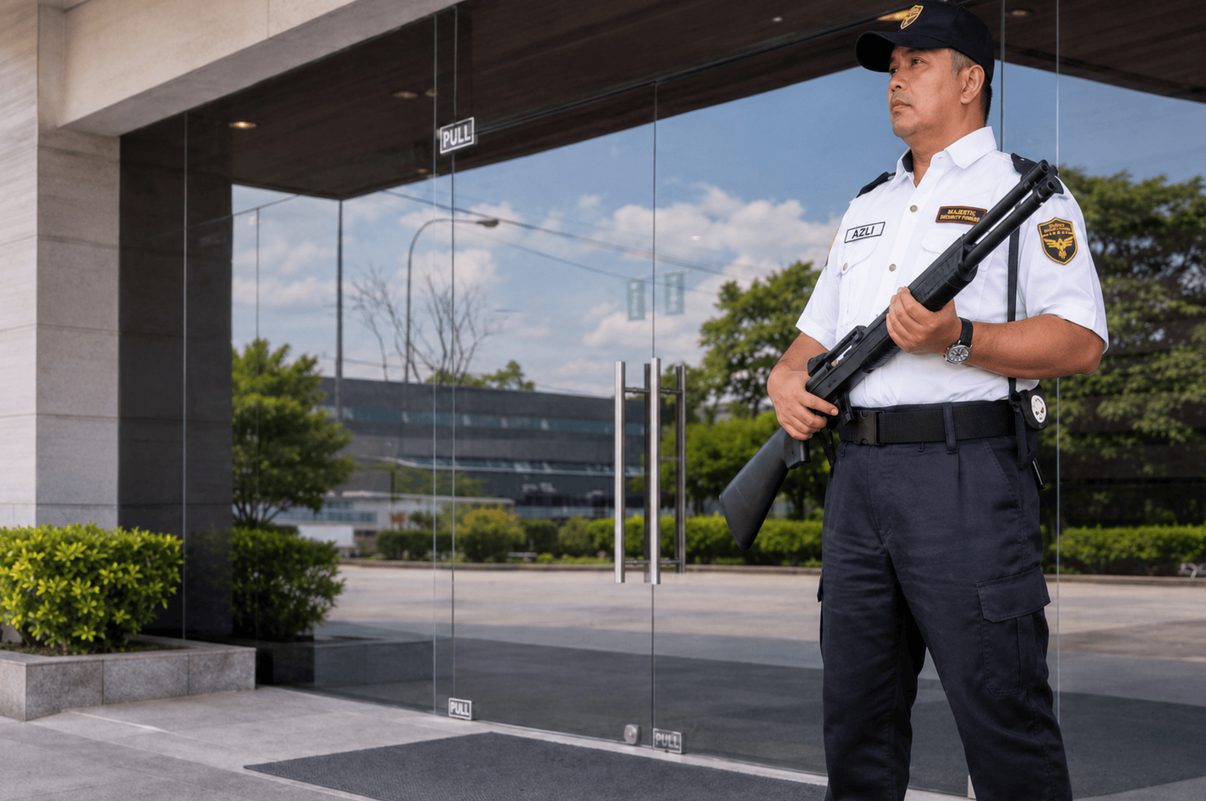
Cash movement, stock value, incident history and the surrounding area reviewed before the question of arms is answered.
Armed posts are arranged under the firearms licensing conditions applying to that site and that deployment.
Post, hours, conditions of deployment and the chain of command agreed on paper before anyone starts.
Escalation and use-of-force instructions written for the assignment rather than inherited from a general template.
The same inspection regime as any other post, with the additional checks the assignment requires.
If the assessment says an unarmed deployment does the job, that is what the quotation will recommend.
Scheduled cash movement where the risk is predictable, concentrated and known to others.
Warehousing or retail where stock value makes the site a target rather than an opportunity.
A documented history changes the assessment in a way that general anxiety does not.
Generally no, and you will hear that the first time you ask. Residential properties in the Klang Valley are far better served by disciplined access control, patrol rounds that happen, and supervision that shows up. An armed post at a family development opens a risk conversation your committee does not want at the next annual general meeting, and it rarely touches the problem residents are complaining about, which is usually the gate.
Armed deployment sits under firearms licensing conditions specific to the site and the assignment, settled before anyone is posted, and separate from the private agency licence itself. Ask any agency to set out the licensing position for your particular site in writing. A vague answer is the answer.
Yes, and it is the sensible order. Start with a properly supervised unarmed deployment, let a few months of incident records build up, then reassess on evidence instead of on how everyone felt after one break-in.
The service most Malaysian properties are really buying.
Read more EscalationA break-in, a fire alarm, a medical case in the lift lobby or a fight at the gate.
Read more DocumentationThis is the document that decides how a stand-in guard behaves at 3am, and it is the one most agencies copy from the last contract.
Read moreSend the property name, how many entry points you have and the shift pattern you run now. You get back a written proposal with the guard count, the roster and the monthly figure. If a smaller deployment does the job, we will say so in the same message.
Request a Site Assessment